
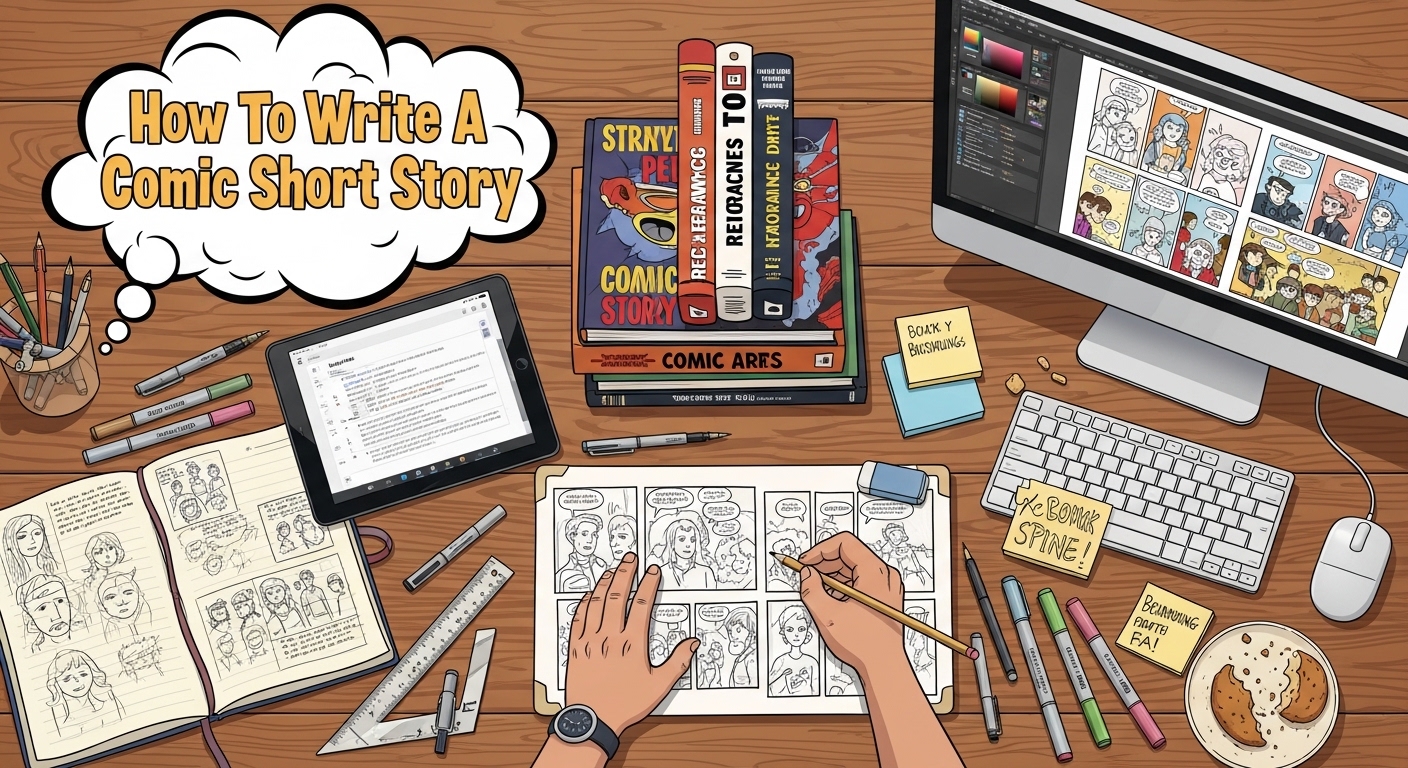
Writing a comic short story is one of the smartest and most accessible ways to step into the world of comics. Unlike full-length graphic novels or ongoing series, a short comic allows you to experiment with storytelling, panel structure, dialogue, pacing, and visual flow — without the pressure of producing a large-scale project. It’s a focused, manageable way to develop your skills and complete a polished piece.
If you’re learning How To Write A Comic Book For Beginners, starting with a short comic story is an excellent training ground. It teaches you how to structure scenes, balance dialogue with visuals, and create emotional impact within limited pages — all essential skills for larger comic projects.
In this guide, you’ll learn how to write a comic short story that feels complete, engaging, and professional. From generating ideas and outlining your plot to scripting panels and preparing for publication, we’ll walk through every step so you can confidently craft a compelling short comic from start to finish.
What Is a Comic Short Story?
A comic short story is a complete narrative told in comic format, typically between:
- 4 to 20 pages
- 500 to 3,000 words (depending on dialogue density)
Unlike long comics, short comic stories focus on:
- One central conflict
- A limited number of characters
- A tight narrative arc
- A strong ending
Think of it as a short film in comic form.
Why Start With a Comic Short Story?
If you’re new to comics, short stories offer major advantages:
- Easier to complete
- Faster feedback from readers
- Lower illustration cost (if hiring an artist)
- Ideal for online publishing or anthologies
- Great portfolio pieces
Many successful comic creators started with short comics before launching full-length series.
Step-by-Step Process: How To Write A Comic Short Story
Below is the complete structured process to write your comic short story effectively.
Step 1: Define Your Core Idea
Every strong comic short story starts with a focused idea.
Ask yourself:
- What is this story about?
- What is the central conflict?
- What emotion do I want readers to feel?
- Who is the main character?
Because it’s short, your concept must be simple and sharp.
Examples of Strong Short Comic Concepts:
- A superhero loses their powers for one day.
- A robot develops emotions unexpectedly.
- A child befriends a monster under their bed.
- A detective solves a mystery in one night.
Avoid complex subplots. Keep it tight.
Step 2: Choose Your Genre
Your genre determines tone, pacing, and visuals.
Common genres for comic short stories:
- Superhero
- Horror
- Sci-fi
- Fantasy
- Romance
- Comedy
- Slice-of-life
- Thriller
Tip: Beginners often succeed faster with genres they already love reading.
Step 3: Limit Your Characters
Short comic stories work best with:
- 1 main character
- 1 antagonist or opposing force
- 1–2 supporting characters (optional)
Too many characters in a short comic leads to confusion and overcrowded panels.
Create a simple character sheet:
| Character | Role | Personality | Visual Traits |
|---|---|---|---|
| Maya | Protagonist | Curious, brave | Short hair, red hoodie |
| The Shade | Antagonist | Mysterious | Shadow-like figure |
Keep designs visually distinct.
Step 4: Outline the Story Structure
Even a 6-page comic needs structure.
Use this simple 4-part framework:
1. Setup (Pages 1–2)
Introduce the character and world.
2. Rising Conflict (Pages 2–4)
Something goes wrong or a challenge appears.
3. Climax (Page 5)
The biggest moment or confrontation.
4. Resolution (Page 6)
Wrap up the story with emotional impact.
Example Outline (6-Page Comic)
| Page | Story Beat |
|---|---|
| 1 | Introduce hero and normal life |
| 2 | Strange event occurs |
| 3 | Conflict escalates |
| 4 | Confrontation builds |
| 5 | Major showdown |
| 6 | Aftermath and closing image |
This ensures your comic short story feels complete.
Step 5: Break It Into Pages and Panels
Comics are visual pacing machines. How you divide pages and panels affects tension and emotion.
Typical panel usage:
- 3–6 panels per page
- 1 large panel for dramatic moments
- Multiple small panels for quick action
Example Page Layout
Page 1:
- Panel 1: Wide shot of city skyline
- Panel 2: Close-up of hero
- Panel 3: Dialogue scene
Important: Don’t overcrowd panels with too much dialogue.
Step 6: Write the Comic Script
Comic scripts look different from prose stories.
Standard comic script format includes:
- Page number
- Panel number
- Visual description
- Dialogue
- Sound effects (SFX)
- Captions (if needed)
Sample Comic Script
Page 1
Panel 1:
A quiet street at night. Streetlights flicker.
CAPTION: “It started like any other night…”
Panel 2:
Maya looks up at the sky.
MAYA: “Did you see that?”
Panel 3:
A shadow stretches unnaturally behind her.
SFX: SHHHHH
Keep descriptions clear but not overly detailed. Artists need guidance, not novels.
Step 7: Keep Dialogue Short and Punchy
In comic short stories:
- Avoid long speeches
- Keep speech bubbles small
- Let art carry emotion
- Cut unnecessary words
Instead of:
“I believe that we should probably consider leaving this place because it seems dangerous.”
Write:
“We need to leave. Now.”
Strong, tight dialogue improves pacing dramatically.
Step 8: Focus on Visual Storytelling
Ask yourself:
- Can this moment be shown instead of told?
- Does the image carry emotion?
- Is the action clear without explanation?
Comics are not illustrated novels — visuals drive the story.
A silent panel can be more powerful than a paragraph.
Step 9: Create a Strong Ending
Short comic stories must end with impact.
Good endings:
- Twist ending
- Emotional payoff
- Visual reveal
- Full-circle moment
- Open-ended mystery
Weak endings feel rushed or abrupt.
Because your story is short, the ending matters even more.
Step 10: Revise and Tighten
Editing is crucial.
Check for:
- Cluttered panels
- Excessive dialogue
- Confusing action
- Weak transitions
- Inconsistent character behavior
Print it out or read it panel-by-panel slowly.
Ask: Does each page move the story forward?
Sample 8-Page Comic Short Story Template
Here’s a practical structure you can use:
| Page | Purpose | Panel Focus |
|---|---|---|
| 1 | Introduce character | Establish setting |
| 2 | Introduce conflict | Inciting moment |
| 3 | Escalation | Tension builds |
| 4 | Complication | Stakes rise |
| 5 | Turning point | Big reveal |
| 6 | Climax | Major action |
| 7 | Resolution | Conflict ends |
| 8 | Final image | Emotional or thematic close |
Tools for Writing a Comic Short Story
You can use:
- Google Docs (for scripting)
- Scrivener
- Final Draft (comic template)
- Canva (basic layout)
- Clip Studio Paint
- Procreate
- Photoshop
If you’re not illustrating yourself, focus on a strong script.
Publishing Options for Comic Short Stories
Once finished, you can:
- Publish as a webcomic
- Submit to comic anthologies
- Self-publish on Amazon KDP
- Share on Webtoon or Tapas
- Print small indie editions
Short comics are excellent for building a portfolio.
How Long Should a Comic Short Story Be?
For beginners:
- 4–8 pages is ideal
- 8–12 pages for stronger narrative
- 16–20 pages for advanced short stories
Start small. Finish fast. Improve with each project.
FAQs: How To Write A Comic Short Story
1. Can I write a comic short story if I can’t draw?
Yes. Many writers collaborate with artists.
2. How many words should a short comic have?
Usually between 500–3,000 words depending on panel density.
3. How long does it take to write one?
You can draft a short comic script in 1–2 weeks.
4. Should I write the script or draw first?
Write the script first. Then storyboard.
5. What makes a comic short story successful?
Clear conflict, tight pacing, strong visuals, and a memorable ending.
Final Thoughts
Learning how to write a comic short story is one of the smartest ways to enter the comic world. It teaches you:
- Story structure
- Panel pacing
- Dialogue economy
- Visual thinking
- Narrative focus
Start small. Finish your first short comic. Then write another.
The key is completion.
Your first comic doesn’t need to be perfect — it needs to exist.
If you’d like, I can also create:
- A fill-in-the-blank comic short story worksheet
- A downloadable page-by-page planning template
- A genre-specific comic short story example
- A monetization strategy guide for indie comic creators
Just tell me what you’d like next.