
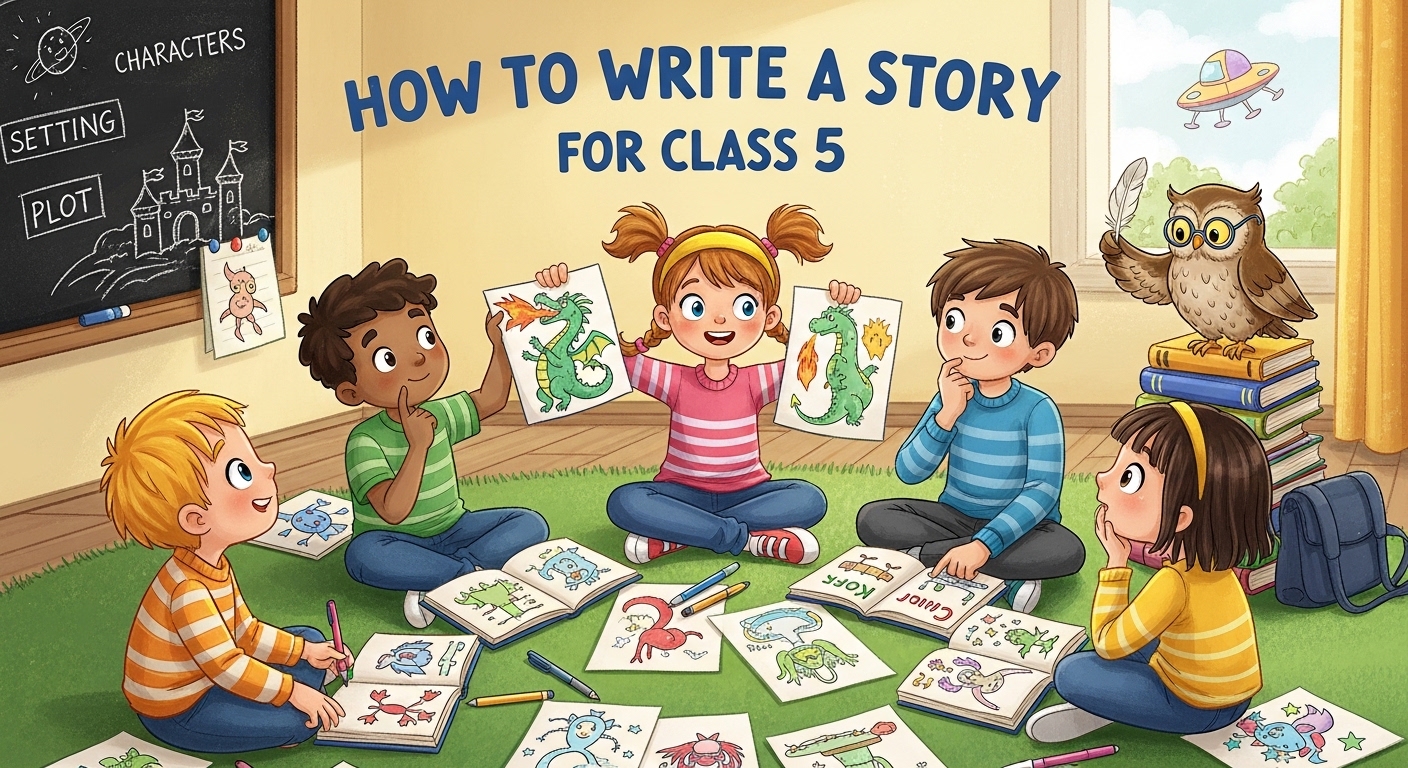
Writing a story in Grade 5 is an important academic and creative milestone. At this level, students are no longer limited to short, simple paragraphs. Instead, they are capable of developing structured, imaginative, and meaningful narratives with clear beginnings, detailed middles, and powerful endings. Their vocabulary is stronger, their sentence structure is more refined, and their ability to express emotions and ideas is much more advanced than in earlier grades.

Grade 5 students are ready to move beyond basic storytelling and begin crafting stories that include well-developed characters, vivid settings, engaging conflicts, rising action, and satisfying resolutions. They can describe feelings, build suspense, use dialogue effectively, and even introduce moral lessons or deeper themes. This stage is where storytelling begins to feel intentional and creative rather than just instructional.

If you are searching for How To Write A Story For Class 9 or looking for guidance on how to help a Grade 5 student improve narrative writing skills, understanding strong story foundations is essential. While Class 9 writing requires deeper analysis, complex themes, and more sophisticated structure, the core storytelling principles begin developing in upper primary grades like Grade 5. Mastering these basics now creates a smooth transition into higher-level creative and academic writing later on.

In this complete guide, you will learn everything you need to know — from understanding story fundamentals and narrative structure to following clear step-by-step writing instructions, creating practical writing timelines, planning potential publishing costs, and applying advanced storytelling techniques that make stories more engaging and memorable. Whether you are a student, parent, or teacher, this guide will help you build confidence and clarity in story writing.

Why Story Writing Is Important in Grade 5

Before jumping into steps, it’s important to understand why story writing matters at this level.

Grade 5 students are developing:

  • Stronger vocabulary
  • Logical thinking skills
  • Creativity and imagination
  • Emotional expression
  • Structured writing abilities

Story writing helps improve all of these areas. It teaches students how to organize ideas clearly, express feelings effectively, and develop critical thinking.

Famous children’s authors like Roald Dahl began with simple storytelling ideas that grew into magical worlds. Even modern classics like Harry Potter and the Sorcerer’s Stone by J.K. Rowling started with one basic idea.

Every great story begins small — just like a Grade 5 story.

Key Elements of a Grade 5 Story

Before writing, students must understand the five essential elements of storytelling:

  1. Characters

These are the people, animals, or creatures in the story.
Grade 5 stories usually include:

  • One main character (hero)
  • One supporting character
  • Possibly a villain or obstacle
  1. Setting

This tells where and when the story happens.
Examples:

  • A haunted house
  • A school playground
  • A jungle adventure
  • A space mission
  1. Plot

The plot is what happens in the story. It includes:

  • Beginning
  • Problem
  • Rising action
  • Climax
  • Ending
  1. Conflict

Every good story needs a problem. Without a problem, there is no excitement.

Examples:

  • Lost in the forest
  • A mysterious new student
  • A magical object causing trouble
  • A competition gone wrong
  1. Resolution

The solution to the problem. This gives readers satisfaction.

Step-By-Step Guide: How To Write A Story For Grade 5

Step 1: Choose an Interesting Topic

A strong topic makes writing easier.

Here are topic ideas for Grade 5 students:

  • The Day I Found a Secret Door
  • My Pet Turned Into a Superhero
  • Lost in the Future
  • The Mysterious School Locker
  • The Magic Treehouse Adventure

Tip: Pick something fun and exciting. When students enjoy the topic, they write better.

Step 2: Create a Story Plan

Planning prevents confusion.

Use this simple structure:

Story Part What To Write
Beginning Introduce character and setting
Problem What goes wrong?
Rising Action Events that build tension
Climax Most exciting moment
Ending How problem is solved

Planning saves time and improves quality.

Step 3: Write a Strong Beginning

The first paragraph should grab attention.

Bad Example:

Once there was a boy.

Better Example:

The moment Arjun opened the old wooden box, the lights in his room began to flicker.

The second example creates curiosity immediately.

Step 4: Build the Middle With Action

The middle should:

  • Develop the problem
  • Add suspense
  • Include dialogue
  • Show emotions

Example dialogue:

“We shouldn’t be here,” whispered Mia, as the door creaked open.

Dialogue makes stories feel alive.

Step 5: Write an Exciting Climax

This is the turning point.

Ask:

  • What is the biggest challenge?
  • How does the hero feel?
  • What decision must be made?

The climax should be the most thrilling part of the story.

Step 6: End With a Clear Resolution

The ending should:

  • Solve the main problem
  • Show what the character learned
  • Feel complete

Avoid sudden endings like:

And then I woke up.

Instead, provide closure.

Story Writing Timeline for Grade 5 Students

Proper time management improves story quality.

5-Day Writing Timeline

Day Task Time Needed
Day 1 Brainstorm ideas 30–45 mins
Day 2 Create story outline 30 mins
Day 3 Write first draft 60 mins
Day 4 Edit and improve 45 mins
Day 5 Final copy submission 30 mins

This timeline reduces stress and improves organization.

2-Week Story Writing Project Timeline (For School Assignments)

Week Focus Goal
Week 1 Planning & Drafting Complete rough draft
Week 2 Editing & Improvement Submit final story

Longer timelines allow deeper creativity.

Important Grammar Rules for Grade 5 Story Writing

Students should focus on:

  • Correct punctuation
  • Paragraph spacing
  • Proper capitalization
  • Dialogue formatting
  • Past tense consistency

Example of correct dialogue format:

“I can’t find the map,” said Riya.
“Look under the table,” replied Kabir.

Story Writing Structure Example (Mini Sample)

Title: The Hidden Cave

Beginning:
Rohan loved exploring the forest behind his house. One afternoon, he noticed something unusual behind a waterfall.

Problem:
When he stepped closer, the rocks shifted, trapping him inside a hidden cave.

Rising Action:
Inside the cave, glowing symbols appeared on the walls. He heard strange sounds echoing.

Climax:
A hidden door opened, revealing an ancient treasure — but it began collapsing.

Ending:
Rohan escaped just in time and promised never to explore alone again.


Importance of Editing in Grade 5 Story Writing

Editing improves:

  • Clarity
  • Grammar
  • Sentence flow
  • Vocabulary

Students should:

  • Read the story aloud
  • Check spelling
  • Remove repeated words
  • Improve boring sentences

Editing can improve marks by 20–30%.

How Teachers Can Grade a Grade 5 Story

Teachers usually check:

Criteria Marks Distribution
Creativity 10
Grammar 10
Structure 10
Vocabulary 5
Presentation 5

Total: 40 Marks (Example)

Understanding grading helps students focus on what matters.

Cost of Publishing a Grade 5 Story (Optional Section for Parents)

If a child wants to publish their story as a small book, here is an estimated cost breakdown:

Item Estimated Cost
Editing $20–$50
Cover Design $30–$100
Printing (50 copies) $100–$200
Online Self-Publishing Often Free

Publishing is optional, but it boosts confidence.

Many platforms allow affordable self-publishing today.

Digital Tools for Story Writing

Students can use:

  • Google Docs
  • Microsoft Word
  • Canva (for cover design)
  • Grammarly (basic grammar help)

Digital writing improves formatting and neatness.

How Parents Can Help Grade 5 Students

Parents should:

  • Encourage daily reading
  • Help brainstorm ideas
  • Avoid writing the story for them
  • Praise effort, not perfection

Reading 20 minutes daily improves storytelling dramatically.

Creative Techniques to Make Stories Better

  1. Use Sensory Details

Instead of:

It was scary.

Write:

The cold wind howled through the broken windows, sending chills down my spine.

  1. Add Dialogue

Dialogue builds personality.

  1. Show, Don’t Tell

Tell:

She was nervous.

Show:

Her hands trembled as she knocked on the door.

Sample Story Prompts for Grade 5

  • A Day Without Electricity
  • The Talking Dog
  • Trapped in a Video Game
  • The Secret Under My Bed
  • When I Became Invisible

These topics inspire imagination.

Advanced Tips for High Marks

If students want top grades:

  • Use varied sentence lengths
  • Add descriptive adjectives
  • Include at least one plot twist
  • Maintain clear paragraph structure
  • Avoid overusing “and then”

Word Count Guidelines for Grade 5

Type of Assignment Suggested Word Count
Short Story 300–500 words
Competition Entry 500–800 words
Project Story 800–1200 words

Clarity is more important than length.

Benefits of Story Writing for Grade 5 Students

Story writing improves:

  • Academic performance
  • Vocabulary skills
  • Confidence
  • Creativity
  • Communication ability

Students who write stories regularly perform better in comprehension and exams.

Frequently Asked Questions (FAQs)

1. How long should a Grade 5 story be?

Typically between 300–800 words, depending on the assignment.

2. How many paragraphs should a Grade 5 story have?

At least 4–6 paragraphs:

  • Introduction
  • Problem
  • Rising events
  • Climax
  • Resolution

3. Can Grade 5 students use dialogue?

Yes! Dialogue improves quality and creativity.

4. How can students improve story writing quickly?

  • Read storybooks
  • Practice writing weekly
  • Learn new vocabulary
  • Edit carefully

5. Should Grade 5 stories always have a moral?

Not always, but adding a lesson can make the story stronger.

6. What tense should be used?

Most Grade 5 stories are written in past tense.

Final Thoughts: How To Write A Story For Grade 5 Successfully

Writing a story in Grade 5 is about imagination, structure, and practice. With the right steps:

  1. Choose a strong idea
  2. Plan your story
  3. Write an exciting beginning
  4. Build tension in the middle
  5. End with a clear resolution
  6. Edit carefully

Story writing is not about perfection — it’s about creativity and improvement.

The more students practice, the better they become.

Every great author once started at this exact stage.

And who knows? The next bestselling storyteller might be in Grade 5 right now. ✨

View All Blogs
Activate Your Coupon
We want to hear about your book idea, get to know you, and answer any questions you have about the ghostwriting and editing process.