
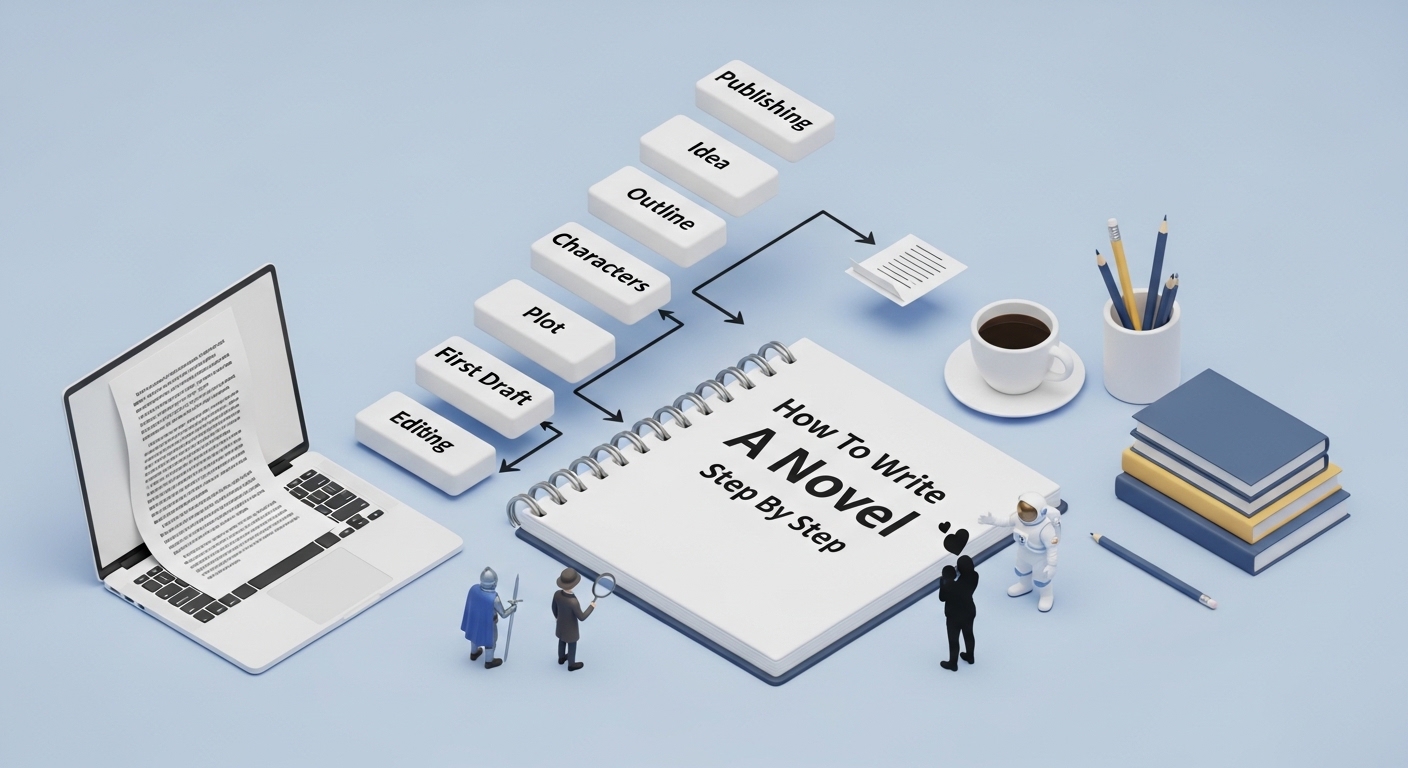
Writing a novel is a goal that captures the imagination of countless people. Some dream of seeing their book on bestseller lists, while others simply want the satisfaction of holding a finished story in their hands. Yet, when it comes time to actually start, many aspiring writers find themselves stuck. The blank page can feel intimidating, ideas may swirl without direction, and doubts often creep in — “Am I good enough? Can I really finish this?”
If you’re looking for how to write a novel step by step, or even ambitious approaches like How To Write A Novel In 30 Days, you need more than motivation. You need a clear, actionable roadmap that guides you from a spark of an idea to a completed manuscript. Without a structured process, the journey can feel endless, frustrating, and overwhelming.
The truth is that writing a novel is rarely about innate talent. While creativity is important, finishing a novel requires discipline, structured planning, and persistence. Every professional author, whether writing epic fantasies, heartwarming romances, or gripping thrillers, has faced the same uncertainty at the start. What separates those who finish from those who don’t isn’t luck — it’s following a proven system that takes them step by step through the process.
In this guide, we will explore how to write a novel step by step, breaking down each stage from brainstorming your initial idea, creating compelling characters, building conflict and structure, to drafting, revising, and preparing for publication. We’ll also cover strategies for writers who want to challenge themselves with more intense timelines, including tips for How To Write A Novel In 30 Days. By following this guide, you’ll gain the clarity, tools, and confidence needed to turn your creative vision into a complete, polished manuscript.
Understanding What a Novel Really Is
Before jumping into steps, you need to understand what defines a novel.
A novel is a long-form fictional narrative, typically between 70,000 and 120,000 words, built around character development, conflict, and transformation. Unlike short stories, novels allow for layered plots, subplots, and deeper emotional arcs.
At its core, every strong novel contains:
- A protagonist with a goal
- Obstacles preventing that goal
- Escalating stakes
- Internal and external conflict
- A climax
- A meaningful resolution
Without these elements, a manuscript feels incomplete — no matter how beautiful the writing is.
Choosing Your Genre and Audience
Your genre determines reader expectations. Writing a fantasy novel requires different pacing and world-building than writing a romance or thriller.
Popular Novel Genres
| Genre | Typical Word Count | Reader Expectations |
| Romance | 70,000–90,000 | Emotional tension, satisfying ending |
| Thriller | 80,000–100,000 | Suspense, twists, fast pacing |
| Fantasy | 90,000–120,000 | World-building, epic stakes |
| Mystery | 75,000–100,000 | Clues, investigation, reveal |
| Literary Fiction | 70,000–100,000 | Character depth, thematic exploration |
Understanding your genre helps shape tone, structure, and marketing strategy.
How To Write A Novel Step By Step
Now let’s break down the full novel writing process.
Step 1: Develop a Strong Core Idea
Every novel starts with a compelling concept. The strongest ideas usually contain built-in conflict.
Ask yourself:
- What if something unexpected happened?
- What does my character want more than anything?
- What is the worst thing that could stand in their way?
Examples of powerful story starters:
- What if a lawyer discovers evidence that incriminates their own sibling?
- What if magic suddenly disappears from the world?
- What if a grieving widow begins receiving messages from her late husband?
Your idea doesn’t need to be revolutionary. It needs to create tension and transformation.
Write your concept in one sentence. This becomes your working premise.
Step 2: Create Compelling Characters
Readers don’t connect with plots — they connect with people.
Your protagonist must have:
- A clear goal
- A flaw or weakness
- Emotional depth
- Internal conflict
- Room to grow
Character Development Framework
| Element | Questions to Answer |
| Goal | What does the character want? |
| Motivation | Why do they want it? |
| Conflict | What blocks them? |
| Flaw | What internal weakness holds them back? |
| Arc | How do they change? |
A strong character arc means the protagonist is not the same person at the end of the novel as they were at the beginning.
Step 3: Define the Central Conflict
Conflict drives the story forward. Without it, there is no tension.
Types of conflict include:
- Character vs. Character
- Character vs. Self
- Character vs. Society
- Character vs. Nature
- Character vs. Supernatural
Your central conflict should escalate. Each obstacle must be harder than the previous one. Stakes must rise as the story progresses.
Step 4: Outline Your Novel Structure
While some writers prefer discovery writing, outlining helps beginners maintain direction.
The Three-Act Structure
Act 1 – Setup (25%)
- Introduce world and characters
- Present inciting incident
- Establish main goal
Act 2 – Confrontation (50%)
- Rising tension
- Complications and obstacles
- Midpoint twist
- Increased stakes
Act 3 – Resolution (25%)
- Climax
- Final confrontation
- Aftermath
This structure ensures pacing remains balanced.
Step 5: Build a Believable Setting
Setting adds depth and realism. Even contemporary fiction requires sensory detail.
Consider:
- Time period
- Geography
- Culture
- Social dynamics
- Political environment
In genres like fantasy or science fiction, world-building is critical. Rules of the world must remain consistent.
Step 6: Break Your Story Into Scenes
A novel is built scene by scene.
Every effective scene should include:
- A goal
- Conflict
- Outcome
This keeps momentum strong.
Scene Structure Example
| Scene Element | Purpose |
| Goal | Character wants something |
| Conflict | Something blocks success |
| Outcome | Situation changes |
If a scene lacks conflict or change, it likely doesn’t belong.
Step 7: Start Writing the First Draft
Now comes execution.
Set realistic writing goals:
- 500–1,000 words per day
- 5 writing sessions per week
- Consistent schedule
Do not edit while drafting. Editing interrupts creativity.
Remember: First drafts are supposed to be imperfect.
Step 8: Manage the Middle of the Novel
Many writers abandon projects during Act 2. The middle feels slow.
To strengthen the middle:
- Add subplots
- Deepen character relationships
- Introduce unexpected complications
- Raise stakes dramatically
Subplots should connect to the main story and enhance character growth.
Step 9: Finish the Draft Completely
Finishing is a psychological victory. Even if the draft feels messy, completing it builds confidence and momentum.
Do not rewrite endlessly before finishing. Momentum matters more than perfection.
Step 10: Take a Break Before Editing
After finishing your manuscript, step away for 2–4 weeks.
Distance allows you to:
- Identify plot holes
- Improve pacing
- Spot inconsistent character behavior
- Remove unnecessary scenes
Fresh perspective improves revision quality.
Step 11: Revise in Layers
Editing happens in stages.
Developmental Editing
- Structural improvements
- Character arc adjustments
- Plot strengthening
Line Editing
- Sentence clarity
- Dialogue tightening
- Tone consistency
Proofreading
- Grammar
- Spelling
- Formatting
Most novels require multiple revision rounds.
Step 12: Get Beta Reader Feedback
External feedback is essential.
Ask beta readers:
- Where did you lose interest?
- Was the ending satisfying?
- Which characters felt realistic?
- Were any scenes confusing?
Accept feedback objectively. You don’t have to apply every suggestion — but listen carefully.
Step 13: Prepare for Publishing
You have two primary publishing paths.
| Traditional Publishing | Self-Publishing |
| Requires agent | No agent needed |
| Slower process | Faster release |
| Publisher handles distribution | Author handles marketing |
| Lower royalties | Higher royalties |
Research both carefully before deciding.
How Long Does It Take To Write A Novel?
It depends on consistency.
| Writing Speed | Time to Complete 80,000 Words |
| 500 words/day | ~5–6 months |
| 1,000 words/day | ~3 months |
| 2,000 words/day | ~6 weeks |
Consistency beats bursts of motivation.
Advanced Tips for Writing a Better Novel
If you want your novel to stand out:
- Start scenes late and end them early
- Show emotion through action, not explanation
- Avoid info-dumping
- Cut unnecessary adverbs
- Focus on strong verbs
- Raise stakes every 5–10 chapters
Professional writing requires intentional craft.
Frequently Asked Questions (FAQs)
1. How do beginners start writing a novel?
Start with a simple idea, define your protagonist, outline basic structure, and commit to daily writing. Focus on finishing your first draft.
2. How many chapters should a novel have?
There is no fixed number. Most novels range between 20 and 40 chapters depending on pacing.
3. Can I write a novel without outlining?
Yes, but outlining reduces plot holes and keeps structure tight.
4. How many words should a novel be?
Most novels fall between 70,000 and 100,000 words. Fantasy may go higher.
5. What is the hardest part of writing a novel?
For many writers, the middle section is hardest because maintaining tension requires strong plotting.
Final Thoughts: Turning Your Idea Into a Finished Novel
Writing a novel step by step is not about waiting for inspiration. It’s about building a repeatable system:
- Develop a strong idea
- Create compelling characters
- Establish conflict
- Outline structure
- Write consistently
- Revise strategically
- Publish intentionally
If you follow this process with discipline, you will finish your novel.
The difference between aspiring writers and published authors is simple:
One group talks about writing a book.
The other sits down and writes it.
Now it’s your turn.