
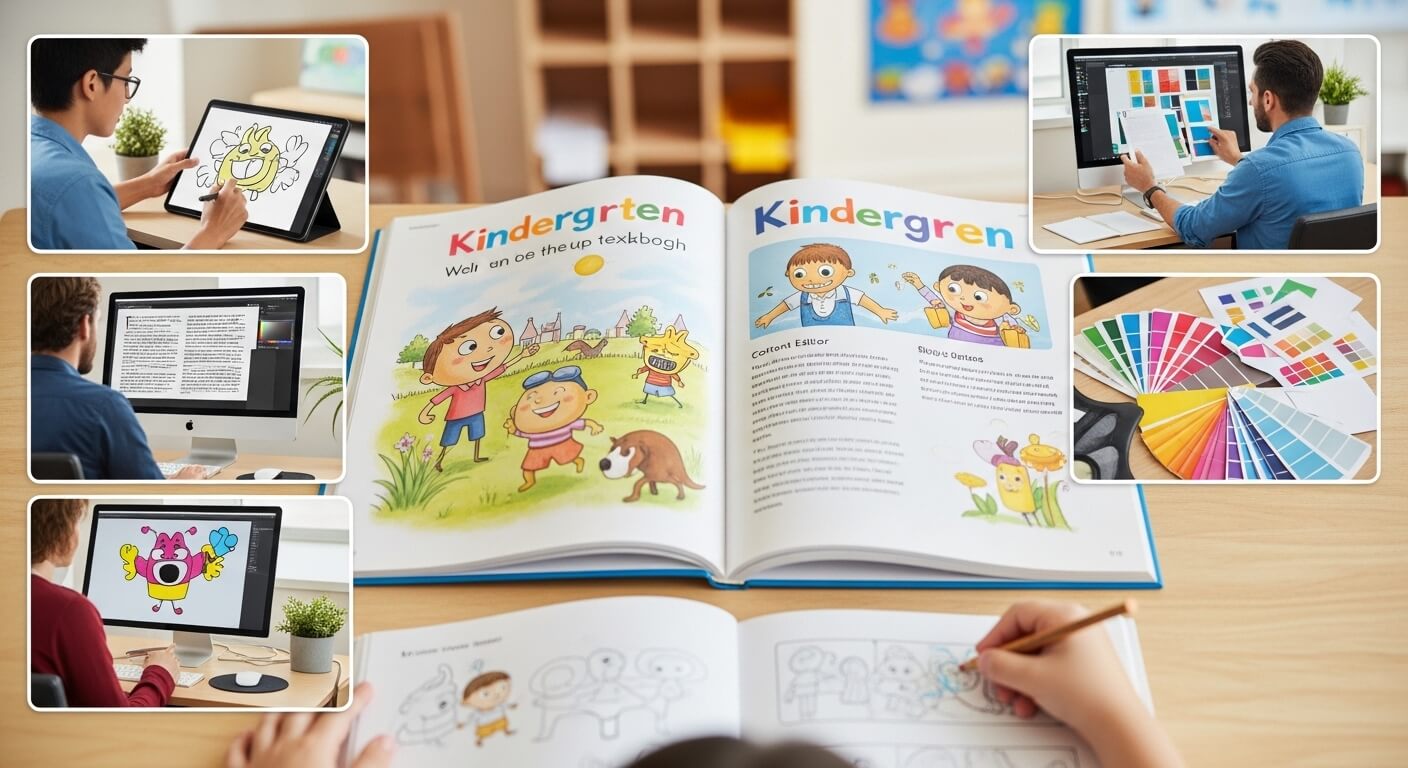
When you open a kindergarten textbook, you see bright colors, simple words, and engaging illustrations. To the untrained eye, it looks like a simple collection of stories and basic math problems. However, behind every page lies a complex web of scientific research, developmental psychology, and rigorous pedagogical standards. Creating educational materials for five- and six-year-olds is one of the most challenging tasks in the publishing industry.Publishers do not simply “write” a kindergarten book; they engineer a learning experience. This process involves aligning with national standards, understanding cognitive milestones, and ensuring that every visual element supports a specific learning objective. In this guide, we will go behind the scenes of the educational publishing world to see how these foundational tools are created and why choosing the right material is critical for a child’s academic trajectory.
The Blueprint: How Publishers Plan Kindergarten Curriculum
The journey of a kindergarten textbook begins long before a single word is written. It starts with a Scope and Sequence. This is a strategic roadmap that outlines exactly what a child should know by the end of the year and the order in which those skills should be introduced.
1. Market Research and Needs Assessment
Publishers begin by analyzing current educational trends and identifying gaps in existing materials. They consult with school districts, state departments of education, and lead teachers to understand the challenges currently faced in the classroom. This phase ensures the content is relevant to modern early childhood education (ECE) environments.
2. Assembling the Expert Panel
A high-quality textbook is never the work of a single author. Publishers assemble teams consisting of:
- Pedagogical Experts: Specialists who understand how young children process information.
- Child Psychologists: To ensure content is emotionally appropriate and promotes social-emotional learning (SEL).
- Curriculum Developers: Professionals who specialize in instructional design and standard alignment.
- Subject Matter Experts: For kindergarten, these are often literacy and numeracy specialists focused on phonemic awareness and number sense.
Deciding Content: The Science of What to Include
Deciding what content makes the cut is a rigorous process. For kindergarteners, the focus isn’t just on facts; it’s on foundational skills. Publishers utilize several frameworks to decide what is essential.
The Role of State and National Standards
In the United States, most publishers align their content with the Common Core State Standards (CCSS) or specific state guidelines like the TEKS in Texas. These standards dictate specific milestones, such as:
- Identifying and naming all upper- and lowercase letters.
- Counting to 100 by ones and tens.
- Understanding the relationship between numbers and quantities.
- Recognizing common types of texts (e.g., storybooks, poems).
Cognitive Load and Age-Appropriateness
Publishers must be careful not to overwhelm a child’s working memory. This is known as managing cognitive load. Content is broken down into “micro-learning” segments. If a lesson is too complex, a child will experience frustration; if it’s too simple, they will disengage. The “Goldilocks zone” of learning is achieved through scaffolding—providing temporary support that is gradually removed as the child masters a skill.
Ensuring Learning Needs are Met: A Multi-Sensory Approach
Young children do not learn through reading alone. They are multisensory learners. Publishers ensure they meet these needs by integrating various learning modalities into the textbook design.
Visual Literacy and Design
In kindergarten textbooks, the illustrations are just as important as the text. Publishers use visual literacy strategies where images provide context clues for the words. For example, if the text says “The apple is red,” the accompanying illustration must clearly show a red apple to reinforce the vocabulary through visual association.
Kinesthetic and Tactile Elements
Modern textbooks often come with “consumable” components—pages designed to be torn out, folded, or colored. This incorporates fine motor skill development into the academic lesson. Publishers also create digital extensions, such as interactive games, to cater to the digital-native generation.
Differentiated Instruction
No two children in a kindergarten classroom are at the same level. Publishers include “Teacher’s Editions” that provide strategies for differentiated instruction. This helps educators adapt the same lesson for a child who is struggling and a child who is gifted, ensuring that the textbook serves the entire learner profile.
Is Any Kindergarten Book Good Enough? The Case for Specific Standards
A common question among parents and new educators is: “Can’t I just use any high-quality picture book or a generic workbook from a local store?” While those materials have their place in supplemental reading, they are not a substitute for a standard-aligned textbook.
The Danger of Gaps in Learning
Generic books often lack a curriculum alignment. They might focus heavily on the alphabet but skip over phonological awareness (the ability to hear and manipulate sounds in spoken language). Standard-aligned textbooks are designed to be “gap-proof,” ensuring that every building block of a child’s education is placed in the correct order.
Evidence-Based Pedagogy
Professional publishers base their content on the Science of Reading and proven mathematical frameworks. A random workbook may use outdated methods that confuse children or fail to prepare them for the rigors of first grade. Standardized textbooks are field-tested; publishers often pilot their materials in real classrooms and collect data on student performance before the final version is released to the public.
The Importance of Continuity
Using books that follow specific guidelines ensures vertical alignment. This means that what a child learns in kindergarten perfectly prepares them for what they will encounter in first grade. Without this continuity, children may face a “learning cliff” where the jump between grade levels becomes too steep to manage.
The Production Process: From Draft to Classroom
Once the content is decided and aligned with standards, the production phase begins. This is where the instructional design meets creative execution.
1. Manuscript Development and Peer Review
Authors draft the lessons, which then undergo several rounds of peer review by active kindergarten teachers. This ensures the language is “teachable” and the timing of the lessons fits within a standard school day.
2. Field Testing and Formative Assessment
Before mass production, the publisher may release a “beta” version to select schools. They observe how students interact with the material. Do they get stuck on page 12? Is the font size too small? This formative assessment of the product itself allows for final tweaks that guarantee success.
3. Sensitivity and Inclusivity Audits
In today’s global environment, publishers perform sensitivity reviews. This ensures that the characters, families, and scenarios depicted in the book reflect a diverse range of cultures, abilities, and backgrounds, fostering a sense of belonging for every student.
Conclusion:
The creation of a kindergarten textbook is an intricate blend of art and science. It requires a deep understanding of developmental milestones, a commitment to pedagogical frameworks, and a strict adherence to educational standards. While it may be tempting to use any colorful book, the structured approach of a professional publisher ensures that children are not just “reading” but are actually building the neural pathways necessary for future academic success.
By prioritizing research-based content and standard-aligned guidelines, publishers provide teachers and parents with a reliable tool to ignite a child’s curiosity and ensure they have the strongest possible start to their educational journey.
Frequently Asked Questions
1. Why can’t I use a standard storybook as a textbook?
Storybooks are excellent for engagement and vocabulary, but they lack the scaffolded instruction and systematic skill-building (like phonics progression and numeracy) found in a standardized textbook designed to meet specific learning benchmarks.
2. What are “Scope and Sequence” in publishing?
The “Scope” refers to the breadth of content covered, while the “Sequence” refers to the specific order in which skills are taught. Together, they ensure that learning builds logically from simple to complex concepts.
3. How do publishers ensure books aren’t too difficult for 5-year-olds?
Publishers use readability formulas and consult with child psychologists to ensure the cognitive load is appropriate. They also field-test the materials in real classrooms to observe student comprehension firsthand.
4. Are digital textbooks as effective as print for kindergarteners?
Research suggests a hybrid approach is best. While digital tools offer multisensory interaction, print materials are essential for developing fine motor skills (like handwriting) and reducing digital fatigue in young children.
5. How often are kindergarten textbooks updated?
Most major publishers update their curriculum every 5 to 7 years. This allows them to incorporate new research in educational psychology, update visual styles, and align with any changes in national or state standards.