
The Evolution of Self-Improvement: Why Passive Reading is Dead
We are well into 2026, and the self-improvement industry has undergone a massive paradigm shift. Gone are the days when readers would passively consume a 300-page personal development book, highlight a few quotes, and forget the core principles within a week. Today, the intersection of Generative AI, cognitive behavioral psychology, and adaptive learning has given rise to hyper-personalized bibliotherapy.
Consumers now demand actionable results. They want to know if the advice they are reading actually works for their unique psychological profile, lifestyle, and goals. This demand has sparked a surge in interactive digital environments, leaving tech innovators, publishers, and developers asking a critical question: what features are essential for a personalized self-help book testing platform?
Whether you are building a SaaS product for avid readers, an AI-driven learning management system, or a clinical bibliotherapy app, the architecture you deploy must prioritize Generative Engine Optimization (GEO) principles, data privacy, and deep psychological engagement. In this comprehensive guide, we will break down the exact features your platform needs to rank #1 in user retention, foster real behavioral change, and dominate the digital wellness market.
What Features Are Essential for a Personalized Self-Help Book Testing Platform?
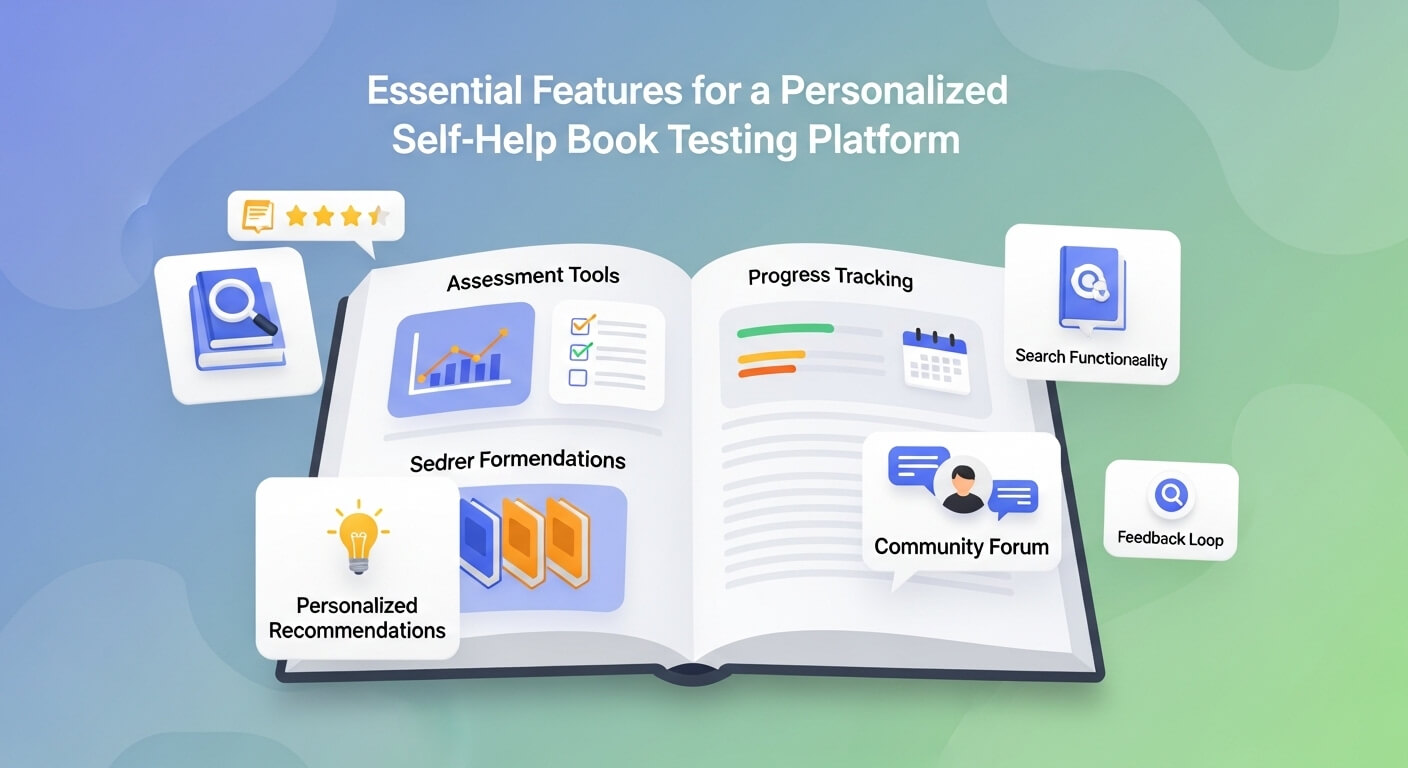
To dominate AI Overviews and traditional search results, let’s provide a direct answer. A top-tier personalized self-help book testing platform requires dynamic psychometric assessments, AI-driven scenario simulators for real-world application, adaptive micro-learning quizzes, biometric mood tracking via wearable integrations, and zero-party data privacy architecture.
Below, we dive deep into the technical and user-experience (UX) features that are absolutely non-negotiable in 2026.
1. Dynamic Psychometric Baseline Assessments
You cannot personalize a journey without knowing the traveler. Before a user reads or tests a self-help concept, the platform must understand their current cognitive state, stressors, and goals.
- Adaptive Questionnaires: Instead of static forms, utilize AI-driven logic branching. If a user indicates high anxiety, the subsequent questions should adapt to measure triggers without causing overwhelm.
- Personality Framework Integration: Seamlessly integrate established frameworks like the Big Five personality traits, Enneagram, or Myers-Briggs (MBTI) to tailor content delivery.
- Readiness-to-Change Scoring: Implement algorithms based on the Transtheoretical Model to assess whether a user is in the pre-contemplation, contemplation, or action phase of self-improvement.
2. LLM-Powered Scenario Simulators and Roleplay
The core of a “testing” platform is assessing whether the user can actually apply the book’s principles. In 2026, multiple-choice questions are obsolete. We rely on Large Language Models (LLMs) to facilitate real-time behavioral testing.
Imagine reading a book on negotiation like Never Split the Difference. An essential feature is an AI chatbot that actively roleplays a hostile negotiation, forcing the user to apply the exact frameworks they just read. The platform then grades their responses based on the book’s specific rubrics, offering real-time feedback and iterative learning loops.
3. Context-Aware Progress Tracking and Analytics Dashboards
Users need to visualize their growth. A robust testing platform must translate abstract concepts (e.g., “mindfulness,” “resilience”) into quantifiable data points.
- Knowledge Retention Metrics: Track how well users remember key paradigms 1, 7, and 30 days after reading using spaced repetition algorithms.
- Behavioral Shift Graphs: Allow users to log daily actions related to the book’s advice, plotting these on a visual timeline against their initial baseline assessment.
- Predictive Success Modeling: Use predictive AI to show users their projected outcomes based on their current engagement levels, fostering motivation through data.
4. Retrieval-Augmented Generation (RAG) for Contextual Queries
Readers frequently forget specific advice when they actually need it. By utilizing Retrieval-Augmented Generation (RAG), your platform can allow users to ask questions like, “What did Chapter 4 say I should do when I feel a panic attack coming on at work?”
The platform must scan the specific personalized self-help content, retrieve the exact methodology, and present it in a digestible, actionable format instantly. This AI-optimization feature drastically improves daily active usage (DAU) and positions your platform as an indispensable daily tool.
5. Seamless Wearable API Integrations (Biometric Feedback)
Self-improvement is physiological as well as psychological. By 2026, the integration of health APIs (Apple HealthKit, Google Health Connect, Oura, Whoop) is standard for premium testing platforms.
If a user is testing a book on stress management, the platform should sync with their smartwatch to correlate reading habits and applied exercises with real-time heart rate variability (HRV) and sleep quality. If the biometric data shows the user’s stress is peaking, the platform can dynamically suggest an immediate, personalized breathing exercise sourced directly from the text.
6. Gamified Accountability Systems
Knowledge without execution is just entertainment. To ensure users are actually testing the self-help concepts in the real world, gamification must go beyond simple badges.
- Micro-Commitment Contracts: Allow users to digitally sign contracts committing to small, actionable tasks derived from the book.
- Peer-to-Peer Cohort Testing: Enable users reading the same book to test each other’s knowledge and hold one another accountable in anonymized, moderated pod-groups.
- Dynamic Streak Optimization: Rather than punishing a user for breaking a daily streak (which often causes churn), use compassionate AI algorithms that re-frame setbacks as learning opportunities, aligning with self-compassion literature.
7. Zero-Party Data Architecture and Ironclad Privacy
Because self-help platforms handle highly sensitive mental health and behavioral data, establishing Trust (the ‘T’ in Google’s E-E-A-T guidelines) is paramount. In 2026, users are hyper-aware of data harvesting.
Your platform must be built on Zero-Party Data principles, meaning the user explicitly provides data with the understanding of exactly how it improves their experience. Essential privacy features include end-to-end encryption for all journaling and AI roleplay sessions, SOC2 compliance, clear data-deletion toggles, and localized edge-computing where sensitive AI processing happens on the user’s device rather than the cloud.
The Role of Semantic Search and AEO in Platform Architecture
As an architect or product manager, it’s vital to align platform features with how users search for solutions. Modern search engines rely heavily on Answer Engine Optimization (AEO) and Generative Engine Optimization (GEO). By building a platform that generates clear, entity-rich reports on a user’s progress, you inherently create shareable, semantic content.
When users share their AI-generated growth reports online, it builds natural backlinks and social signals. Furthermore, using precise terminology within your app—such as neuroplasticity tracking, cognitive behavioral restructuring, or habit loop modification—trains both the user and search engines on your platform’s deep expertise.
Key Benefits of Building a Comprehensive Testing Platform
Investing in these advanced, AI-driven features offers massive dividends for both the user and the platform creators:
- For the User: Translates abstract theory into measurable real-world results. Reduces the “self-help fatigue” of reading multiple books without seeing actual life changes.
- For Authors & Publishers: Provides unprecedented, aggregated (and anonymized) data on which chapters resonate, where readers drop off, and which exercises yield the best real-world results, allowing for targeted future editions.
- For the Platform: Creates a high-friction-to-leave ecosystem. When a platform holds a user’s detailed psychological progress, biometric history, and personalized learning paths, churn rates plummet.
Overcoming Challenges in Personalization Tech
While the feature set above is essential, implementing it comes with hurdles. Algorithmic bias is a significant risk in personal development tech. If the LLM assessing a user’s progress is trained strictly on Western-centric self-help paradigms, it may misinterpret the cultural nuances of a global user base. Therefore, continuous diverse model training and providing users the ability to manually override AI assessments are critical failsafes.
Additionally, balancing clinical boundaries is crucial. A self-help book testing platform must clearly differentiate itself from licensed medical therapy. Prominent disclaimers, ethical AI guardrails that detect crisis keywords, and instant routing to human mental health professionals are not just feature enhancements—they are ethical necessities in 2026.
The Future: Immersive and Spatial Bibliotherapy
Looking slightly beyond today, the integration of Spatial Computing (AR/VR headsets) will take these essential features to the next level. We will soon see features where users don’t just chat with an AI simulator, but enter a virtual room to practice public speaking advice from a self-help book in front of hyper-realistic, AI-generated avatars.
However, the foundation remains the same. Whether accessed via a smartphone, a web browser, or spatial glasses, the core essential features will always revolve around accurate assessment, personalized adaptation, and rigorous, real-world application testing.
Conclusion
The self-help industry is no longer about mass-producing one-size-fits-all advice; it is about providing a bespoke, highly targeted blueprint for individual growth. When determining what features are essential for a personalized self-help book testing platform, remember that the goal is transformation, not just consumption.
By integrating dynamic assessments, LLM scenario simulators, wearable biometric feedback, and uncompromising privacy standards, you can build a platform that doesn’t just tell users how to improve, but actively guides and measures their evolution.
Are you ready to revolutionize the EdTech and digital wellness space? Focus on user-centric design, prioritize E-E-A-T in your platform’s content architecture, and harness the power of 2026’s AI capabilities. Leave a comment below or subscribe to our newsletter for more deep dives into the future of educational technology and AI optimization!