
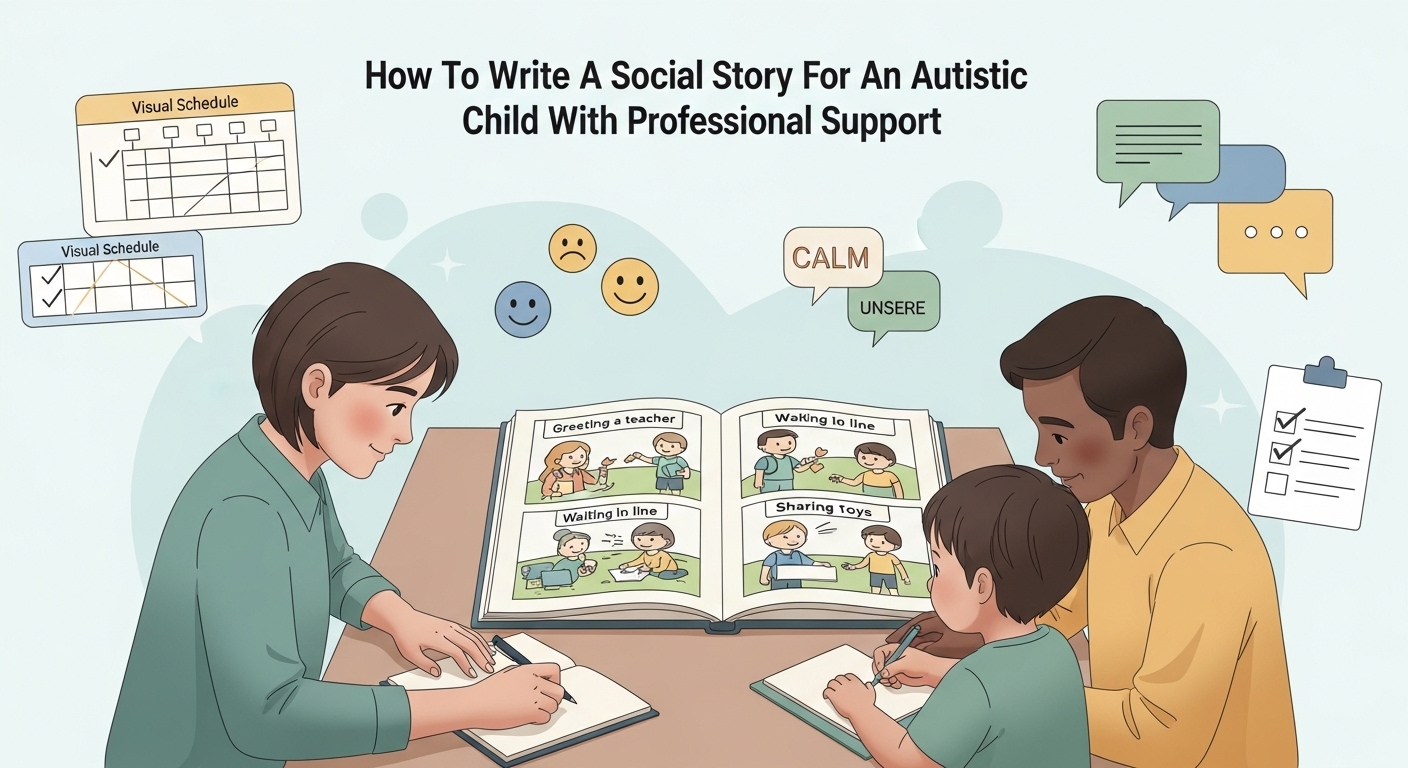
A social story is a short, structured narrative designed to help an autistic child understand specific social situations, expectations, behaviors, or daily routines. Developed in the early 1990s by Carol Gray, social stories were created to support children on the autism spectrum in interpreting social cues and responding appropriately.
Social stories are widely used across:
-
Special education classrooms
-
Autism therapy programs
-
Occupational therapy sessions
-
Speech therapy interventions
-
Home-based routines
They are especially valuable for children diagnosed with Autism Spectrum Disorder (ASD), who may face challenges such as:
-
Social communication difficulties
-
Sensory sensitivities
-
Managing transitions and routines
-
Emotional regulation
-
Understanding unspoken social rules
Autistic children often thrive on predictability, structure, and visual information. A well-written social story breaks down complex situations into manageable steps, reduces anxiety, encourages positive behavior, and supports emotional understanding, ultimately fostering greater independence.
When created with professional support—such as guidance from a special educator, psychologist, Board Certified Behavior Analyst (BCBA), speech therapist, or occupational therapist—the story becomes even more effective and personalized.
Interestingly, writing a social story shares a key principle with other structured writing projects: clarity, planning, and a step-by-step approach are essential for success, much like the strategies used in guides such as How to Write a Self-Help Book in 30 Days. Both require breaking down complex information into simple, actionable steps that the reader—or in this case, the child—can understand and follow.
What Is Professional Support in Social Story Writing?
Professional support means collaborating with trained experts who understand:
- Child development
- Autism characteristics
- Behavioral strategies
- Sensory processing
- Communication styles
Professionals help:
- Identify the root cause of challenging behavior
- Ensure the story uses developmentally appropriate language
- Avoid negative or shaming tone
- Structure the story correctly
- Track progress and modify as needed
Professional involvement is especially recommended when the child:
- Has intense meltdowns
- Displays aggressive behaviors
- Experiences school refusal
- Struggles with major life transitions
Key Elements of an Effective Social Story
Before writing, understand the core components of a high-quality social story.
Types of Sentences Used in Social Stories
According to best practices developed by Carol Gray, social stories include different sentence types.
| Sentence Type | Purpose | Example |
| Descriptive | Describes facts about the situation | “Sometimes I go to school.” |
| Perspective | Describes thoughts/feelings of others | “My teacher feels happy when I listen.” |
| Directive | Gently guides behavior | “I will try to raise my hand.” |
| Affirmative | Reinforces values or rules | “Listening is a good choice.” |
| Cooperative | Explains who will help | “My mom can help me if I feel upset.” |
| Control | Child-generated reminder | “I can take deep breaths.” |
A well-balanced social story typically contains:
- More descriptive and perspective sentences
- Fewer directive sentences
This ensures the story informs rather than commands.
When Should You Write a Social Story?
Social stories are ideal for:
- Starting school
- Visiting the doctor
- Haircuts
- Birthday parties
- Sharing toys
- Using the bathroom
- Transitioning between activities
- Coping with loud noises
- Handling frustration
They are also effective for:
- Toilet training
- Bedtime routines
- Managing screen time
- Public behavior
- Fire drills
How To Write A Soial Story For An Autistic Child (Step-By-Step)
Now let’s move into the practical part.
Step 1: Identify the Target Behavior or Situation
Be specific.
Instead of:
“Improve behavior.”
Define:
“Reduce anxiety when entering the classroom.”
Questions to Ask:
- What exactly is happening?
- When does it occur?
- What triggers it?
- What skill is missing?
- What outcome do we want?
Professionals can conduct behavioral assessments to determine the function of behavior (escape, attention, sensory, etc.).
Step 2: Gather Information About the Child
Personalization is critical.
Consider:
- Age
- Language level
- Reading ability
- Cognitive level
- Sensory triggers
- Interests (e.g., trains, dinosaurs, superheroes)
- Visual vs verbal preference
| Child Factor | Why It Matters |
| Reading level | Determines vocabulary complexity |
| Sensory profile | Helps include coping strategies |
| Interests | Increases engagement |
| Emotional triggers | Helps address anxiety directly |
Professionals may use assessment tools or observation notes.
Step 3: Define the Goal Clearly
Write a measurable goal.
Example:
“Child will enter classroom calmly without crying on 4 out of 5 days.”
Having a measurable goal allows professionals to track progress.
Step 4: Write the Story Using Clear, Positive Language
Writing Guidelines:
- Use first-person (“I” statements)
- Keep sentences short
- Avoid negative wording (“don’t,” “stop,” “bad”)
- Stay calm and reassuring
- Be literal and concrete
- Use present or future tense
Example: Social Story for Starting School
Title: Going to School
“Every morning, I go to school.
School is a place where children learn and play.
My teacher is there to help me.
Sometimes I may feel nervous. That is okay.
Other children may feel nervous too.
When I feel nervous, I can take deep breaths.
I can hold my favorite toy in my backpack.
My mom will pick me up after school.
I am learning to be brave at school.”
Step 5: Add Visual Supports
Many autistic children are visual learners.
Include:
- Photos of real locations
- Pictures of the child
- Simple illustrations
- Visual schedules
- Emotion icons
| Visual Type | Best Used For |
| Real photos | School, doctor visits |
| Cartoon drawings | Emotions |
| Visual schedules | Routines |
| Social scripts | Conversation practice |
Professionals like speech therapists and occupational therapists can recommend appropriate visuals.
Step 6: Review with a Professional
A professional can:
- Ensure correct sentence balance
- Adjust tone
- Remove unintended pressure
- Add sensory coping strategies
- Align with therapy goals
For example, a BCBA may integrate Applied Behavior Analysis (ABA) strategies, while a speech therapist may adjust communication phrasing.
Step 7: Introduce the Social Story at the Right Time
Do NOT introduce during a meltdown.
Best times:
- Calm moments
- Before the situation occurs
- During routine reading time
- As part of bedtime
Frequency:
- Read daily at first
- Review before target event
- Gradually fade when behavior improves
Step 8: Monitor and Adjust
Track progress using data.
| Date | Situation | Reaction | Improvement? |
| Day 1 | School entry | Crying | No |
| Day 5 | School entry | Mild hesitation | Yes |
| Day 10 | School entry | Calm | Significant |
If the story isn’t working:
- Simplify language
- Add visuals
- Shorten story
- Address a different trigger
Advanced Strategies with Professional Support
- Pairing Social Stories with Behavior Plans
Professionals may combine social stories with:
- Positive reinforcement systems
- Token boards
- Visual schedules
- Sensory breaks
- Communication supports
- Using Social Stories for Emotional Regulation
A psychologist may help write stories focused on:
- Identifying emotions
- Coping with anger
- Managing disappointment
- Asking for help
Example coping phrases:
- “I can take three deep breaths.”
- “I can ask for a break.”
- “It is okay to feel upset.”
- Customizing for Different Age Groups
Preschool Children
- 4–6 sentences
- Large visuals
- Simple vocabulary
Elementary School
- 8–12 sentences
- Include peer perspectives
Pre-teens
- More detailed explanations
- Include independence skills
Good — this is exactly the kind of section that separates average blogs from authority content.
How Long Should a Social Story Be?
One of the most common questions parents and educators ask is: How long should a social story for an autistic child be?
The ideal length depends on the child’s developmental level, attention span, language comprehension, and processing ability. A social story should always be long enough to explain the situation clearly — but short enough to maintain engagement.
Recommended Length by Age Group
| Age Group | Suggested Length | Why |
| Toddlers (2–4 years) | 4–6 simple sentences | Short attention span, emerging language skills |
| Young Children (5–8 years) | 6–10 sentences | Can process simple sequences and emotions |
| Older Children (9–12 years) | 10–15 sentences | Better comprehension of perspective and reasoning |
| Teens | 12–20 concise statements | Able to understand abstract explanations |
However, quality matters more than length.
A well-written 6-sentence social story that directly addresses the child’s anxiety trigger is more effective than a 15-sentence story filled with unnecessary detail.
Signs Your Social Story Is Too Long
- The child loses focus before finishing
- They resist reading it
- They appear confused
- Repetitive language overwhelms them
When writing social stories for autism, clarity and emotional safety should always come first.
If working with a professional such as a BCBA or speech therapist, they may adjust the length based on cognitive assessments or communication goals.
Integrating Social Stories Into Daily Routines
A social story is not a one-time fix — it becomes effective through consistent, calm repetition.
The best results occur when the story is introduced during neutral or positive moments, not during a meltdown or behavioral crisis.
Practical Ways to Reinforce Learning
- Keep printed copies in backpacks for school transitions
- Laminate and bind into mini-books for durability
- Store digital versions on a tablet for easy access
- Pair reading with role-play practice
- Review during bedtime routines
- Read before the triggering situation occurs
- Model the behavior while reading
Professionals often recommend pre-teaching the situation. For example, if the social story is about visiting the dentist, read it several times in the week leading up to the appointment.
Why Routine Matters for Children With Autism
Children diagnosed with Autism Spectrum Disorder often thrive on predictability. Repeated exposure to the same structured narrative builds familiarity, which reduces anxiety and improves emotional regulation.
Consistency turns the social story from “just a book” into a cognitive script the child can rely on.
Measuring the Success of a Social Story
A social story should not only feel helpful — its impact should be observable.
Parents and professionals should track behavioral changes over time to determine whether the intervention is effective.
Key Success Indicators
- Reduced frequency of meltdowns
- Lower intensity of emotional reactions
- Increased compliance with instructions
- Improved social communication
- Shorter recovery time after distress
- Greater independence in targeted situations
However, improvement is rarely immediate.
How Long Should You Track Progress?
Track behavior consistently for 2–4 weeks before evaluating effectiveness.
Some children respond within days. Others need repetition and reinforcement.
Sample Progress Tracking Table
| Date | Situation | Behavior Intensity (1–5) | Duration | Coping Used | Notes |
| Week 1 | School entry | 5 | 15 min | None | Crying |
| Week 2 | School entry | 3 | 7 min | Deep breathing | Less resistance |
| Week 3 | School entry | 2 | 3 min | Held teacher’s hand | Significant improvement |
Tracking allows you to:
- Identify patterns
- Adjust the story if needed
- Share progress with therapists
- Decide whether professional support should be expanded
If no improvement is seen after consistent implementation, a behavior professional may reassess the function of the behavior and modify the social story accordingly.
Benefits of Writing a Social Story with Professional Support
- Evidence-based structure
- Behavior-specific guidance
- Sensory-aware adjustments
- Language adapted to developmental level
- Measurable goals
- Faster behavioral progress
Parents often feel more confident when supported by specialists.
Example Social Story Template
Below is a customizable template:
Title: [Situation]
- Sometimes I [describe situation].
- [Explain where/when it happens].
- Other people may [describe others’ perspectives].
- I might feel [emotion].
- When I feel [emotion], I can [coping strategy].
- [Trusted adult] can help me.
- This helps everyone feel safe and happy.
Frequently Asked Questions (FAQs)
1. What is the main purpose of a social story for an autistic child?
The main purpose is to help the child understand social situations, expectations, and appropriate responses in a clear and structured way.
2. Who can write a social story?
Parents, teachers, therapists, or psychologists can write one. However, professional support ensures accuracy, effectiveness, and personalization.
3. How often should a social story be read?
Daily at first, especially before the triggering situation. Gradually reduce once behavior improves.
4. Can social stories replace therapy?
No. They are a supportive tool, not a replacement for therapy. They work best as part of a comprehensive intervention plan.
5. What if the child refuses to read the social story?
- Try adding favorite characters
- Shorten the story
- Use visuals
- Read at a calm time
- Consult a professional for modification
Final Thoughts
Learning how to write a social story for an autistic child with professional support is not just about writing sentences—it’s about understanding the child’s world.
With the right structure, positive language, visuals, and expert guidance, social stories can:
- Reduce anxiety
- Improve behavior
- Strengthen emotional regulation
- Increase independence
- Build confidence
If your child faces ongoing social or behavioral challenges, collaborating with a trained professional can significantly enhance the impact of your social stories.
Social stories are simple—but when done correctly, they are life-changing.