
Introduction: Entering a World Where Logic Breaks
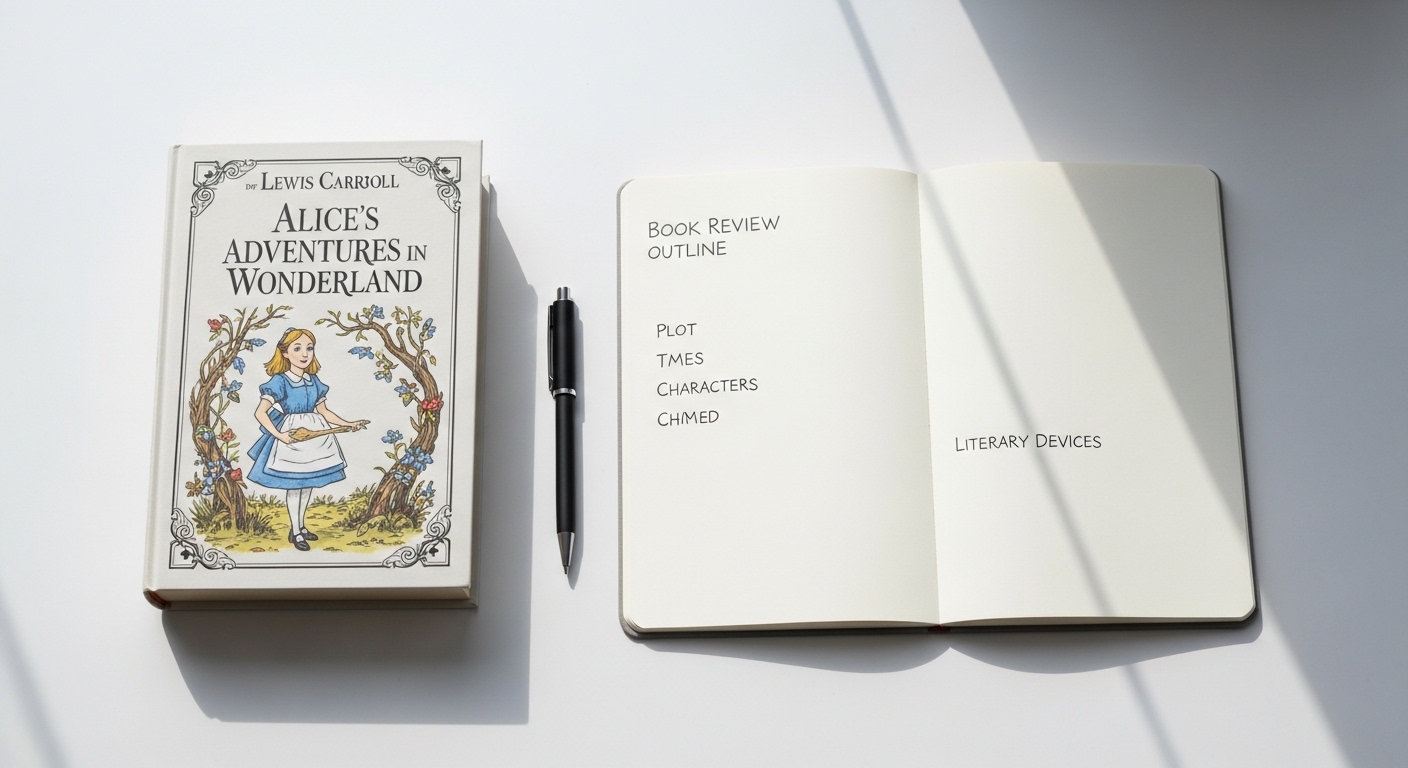
First published in 1865, Alice’s Adventures in Wonderland by Lewis Carroll remains one of the most imaginative and intellectually intriguing works in English literature. What appears on the surface to be a whimsical children’s fantasy is, in reality, a layered exploration of identity, logic, language, and authority. Over 150 years later, the novel continues to inspire adaptations, scholarly debate, and reinterpretations — including the visually striking 2010 film adaptation directed by Tim Burton.
A strong book review of this novel must go beyond plot summary. It should explore how Carroll constructs Wonderland, why the characters behave as they do, and what deeper meanings may be hidden beneath the nonsense. This review will examine the novel’s themes, characters, writing style, structure, cultural significance, and lasting impact while offering a thoughtful evaluation of its strengths and limitations.
Brief Summary of the Story
The novel begins with young Alice sitting by a riverbank when she notices a White Rabbit dressed in a waistcoat, anxiously checking his pocket watch. Curious, she follows him down a rabbit hole and falls into a strange world known as Wonderland.
Throughout her journey, Alice encounters a series of bizarre characters: the ever-smiling Cheshire Cat, the eccentric Mad Hatter and March Hare at an endless tea party, the philosophical Caterpillar, and the tyrannical Queen of Hearts who frequently orders executions. Events unfold in an episodic manner, with Alice moving from one strange encounter to another.
Eventually, Alice finds herself at a chaotic trial presided over by the Queen. As the absurdity escalates, Wonderland begins to collapse, and Alice awakens from what appears to have been a dream.
The storyline is simple, yet the experiences within it are anything but ordinary.
Thematic Analysis
1. Identity and Self-Discovery
One of the most significant themes in Alice’s Adventures in Wonderland is identity. Throughout the novel, Alice repeatedly changes size — sometimes shrinking to a few inches tall, other times growing so large that she fills entire rooms. These transformations symbolize the instability and confusion of childhood.
At multiple points, Alice asks herself, “Who in the world am I?” This question lies at the emotional center of the novel. Wonderland forces her to confront uncertainty about her own identity, mirroring the universal experience of growing up.
The physical instability of her body parallels emotional instability. She struggles to maintain confidence in a world where rules constantly change. In this sense, Wonderland becomes a metaphor for adolescence — a time when logic feels unreliable and authority figures seem arbitrary.
Carroll does not offer clear answers. Instead, he presents identity as fluid, uncertain, and shaped by experience.
2. Logic, Language, and Absurdity
Lewis Carroll, whose real name was Charles Lutwidge Dodgson, was a mathematician. His fascination with logic is evident throughout the novel. However, rather than using logic to create order, he uses it to produce absurdity.
Conversations in Wonderland often follow grammatical structure but lead nowhere. The Mad Hatter’s riddles, the Caterpillar’s questioning, and the Duchess’s moralizing all parody rational thought.
For example, the Mad Hatter asks, “Why is a raven like a writing desk?” — a riddle without an answer in the original text. This deliberate lack of resolution challenges the reader’s expectation that every question must have meaning.
Carroll’s playful manipulation of logic invites readers to question whether adult reasoning is always as rational as it claims to be. The absurd conversations may reflect the way children perceive adult conversations — confusing, circular, and sometimes illogical.
3. Authority and Power
The Queen of Hearts is one of literature’s most memorable tyrants. Her frequent command, “Off with their heads!” demonstrates exaggerated and irrational authority.
Despite her dramatic threats, few executions actually occur. This suggests that her power is performative rather than effective. Carroll may be subtly critiquing rigid Victorian social hierarchies and authoritarian figures.
Alice, notably, grows more confident when confronting the Queen. By the novel’s climax, she openly challenges the court’s nonsense, signaling personal growth and intellectual independence.
The theme of power in the novel highlights the absurdity of unquestioned authority.
Character Evaluation
Alice: The Rational Observer
Alice serves as the emotional anchor of the story. Unlike the eccentric figures she encounters, she attempts to apply reason and manners to every situation.
Her politeness often contrasts sharply with the chaotic environment around her. Over time, she becomes more assertive, suggesting subtle character development.
Alice represents curiosity and critical thinking. She questions everything, even when the answers are unsatisfying.
The Cheshire Cat: Philosophical Guide
The Cheshire Cat appears and disappears at will, leaving behind only its grin. Unlike other characters, the Cat seems aware of the absurdity of Wonderland.
Its famous statement — “We’re all mad here” — encapsulates the novel’s tone. The Cat does not offer solutions but instead embraces chaos.
Symbolically, the Cheshire Cat may represent perspective. It observes events without becoming emotionally involved.
The Mad Hatter: Embodiment of Nonsense
The tea party scene featuring the Mad Hatter is one of the most iconic moments in the novel. Time has stopped at six o’clock, and the characters are trapped in endless tea.
This scene critiques social customs and rigid politeness. The endless tea party reflects stagnation and circular conversation.
The Hatter’s character emphasizes the playful yet unsettling atmosphere of Wonderland.
The Queen of Hearts: Caricature of Tyranny
The Queen’s exaggerated rage and constant threats serve as both comic relief and political satire. Her character is intentionally overdramatic.
Despite her authority, she lacks real control. By the novel’s end, her power dissolves as Wonderland collapses.
Writing Style and Structure
Carroll’s writing style is playful, poetic, and imaginative. The novel includes poems, songs, riddles, and parodies of traditional nursery rhymes.
The language is accessible yet layered with intellectual humor. Children may enjoy the absurdity, while adults may appreciate the satire and wordplay.
However, the structure is episodic rather than linear. Events do not build toward a traditional climax in the conventional sense. Instead, the narrative moves like a dream — fragmented and unpredictable.
This structure strengthens the surreal tone but may frustrate readers who prefer cohesive storytelling.
Strengths of the Novel
One of the novel’s greatest strengths is its originality. Few works in literary history have created a world as distinctive as Wonderland.
The characters are unforgettable. Even readers who have not read the book often recognize the Mad Hatter, Cheshire Cat, and Queen of Hearts.
The linguistic creativity stands out as another major strength. Carroll’s clever wordplay continues to inspire modern writers.
Additionally, the novel’s open-ended symbolism allows for multiple interpretations. Readers can revisit the text at different ages and discover new meanings.
Limitations of the Novel
Despite its strengths, the novel is not without limitations.
The episodic structure can feel disjointed. There is minimal character development beyond Alice’s gradual confidence.
Some Victorian-era references and parodies may feel outdated to modern readers unfamiliar with 19th-century culture.
Additionally, readers seeking a strong emotional arc may find the dream framework less impactful than plot-driven narratives.
However, these limitations are often part of what makes the novel unique.
Cultural and Literary Significance
Alice’s Adventures in Wonderland helped redefine children’s literature. During the Victorian era, many children’s books focused heavily on moral lessons. Carroll broke from this tradition by prioritizing imagination over instruction.
The novel has influenced fantasy literature, surrealism, psychology, and even philosophy. It continues to be studied in academic settings worldwide.
Its adaptability across media — from illustrated editions to films — demonstrates its enduring appeal.
The fact that it remains widely read more than a century after publication highlights its timeless quality.
Personal Evaluation
Reading Alice’s Adventures in Wonderland is a unique experience. It demands flexibility from the reader. Those expecting a clear plot with rising tension and resolution may struggle with its dreamlike structure.
However, readers willing to embrace unpredictability may find it intellectually stimulating and delightfully imaginative.
The novel rewards careful attention. Beneath its nonsense lies commentary on identity, authority, and logic.
It is a book that invites rereading.
Conclusion: Why the Novel Still Matters
More than 150 years after its publication, Alice’s Adventures in Wonderland continues to captivate readers across generations. Its imaginative world, symbolic characters, and playful language ensure its place as a literary classic.
While unconventional in structure, the novel’s creativity and intellectual depth outweigh its limitations. It is best suited for readers who appreciate symbolic storytelling and imaginative experimentation.
Ultimately, Alice’s Adventures in Wonderland remains not just a children’s story but a timeless exploration of curiosity, logic, and the human search for meaning in a confusing world.