
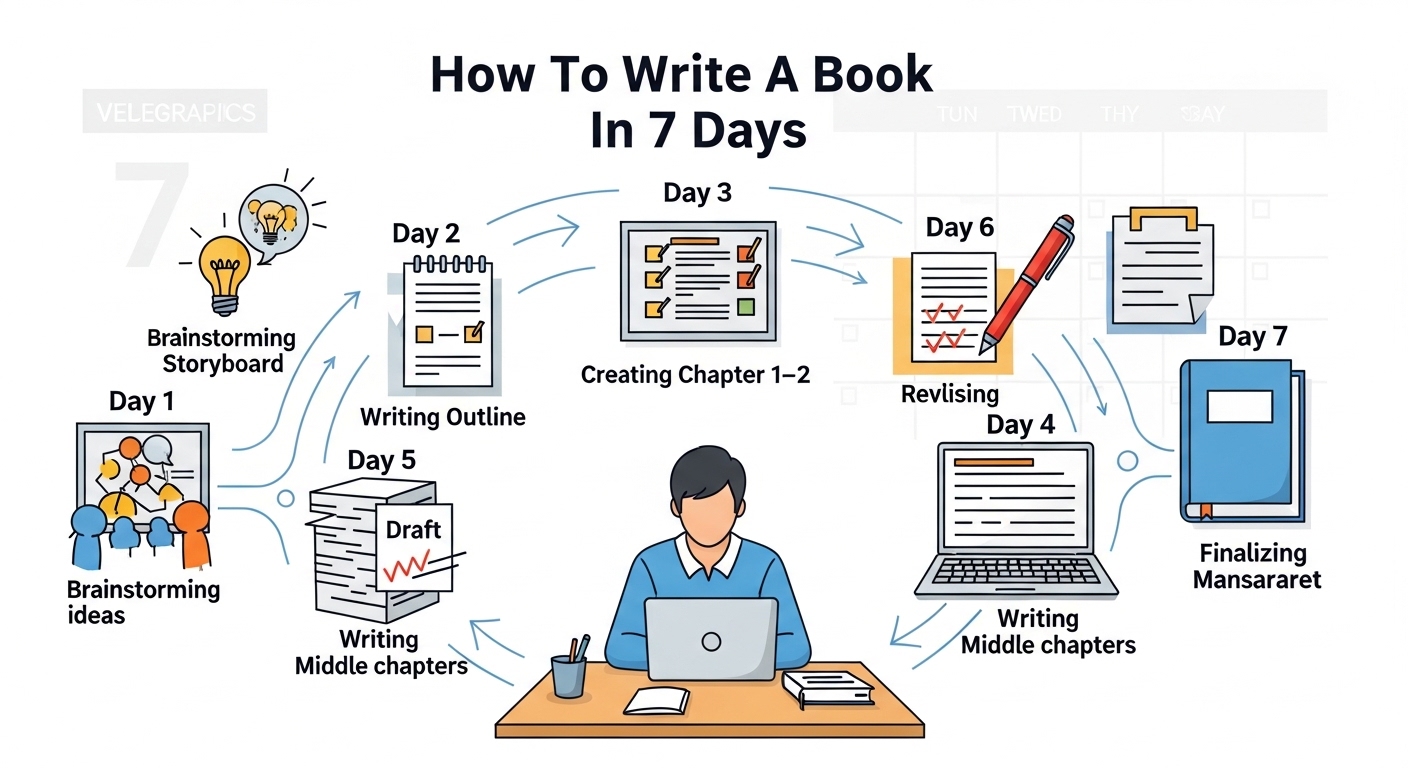
How To Write A Book In 7 Days: The Ultimate One-Week Writing Sprint
Writing a book is usually considered a months-long journey, but under the right strategy, it’s possible to complete a full manuscript in just 7 days. While this sounds intense—and it is—it is achievable if your focus is on producing a first draft, not a fully polished, publication-ready book.
Learning takes that intensity even further. It demands sharper planning, longer writing sessions, and an even stronger commitment to execution. The key difference is compression: instead of spreading momentum across a week, you concentrate it into five highly structured, high-output days. This approach is not about rushing creativity; it’s about preparing so thoroughly that drafting becomes a matter of disciplined execution.
Learning how to write a book in 7 days is about maximizing productivity, maintaining discipline, and working with a structured plan. This is a high-intensity, fast-paced process designed for writers who are ready to dedicate focused time every day, minimize distractions, and prioritize execution over perfection.
If you’re exploring How To Write A Book In 5 Days, the mindset shift becomes even more important. You must accept that your first draft will be imperfect. You must silence your inner editor. And most importantly, you must treat the five-day window like a professional deadline rather than a casual writing challenge. The faster timeline forces clarity. There is no room for indecision about plot direction, character arcs, or chapter structure. Those elements must be mapped before day one begins.
The advantage of this accelerated method is momentum. When you write intensively over a short period, your ideas stay fresh. Characters remain emotionally alive. The story world does not fade between sessions. Many writers discover that compressed timelines actually improve narrative consistency because they reduce the gaps where doubt and distraction usually creep in.
Why Writing a Book in 7 Days Is Possible
Many aspiring authors think writing a book requires months of research, drafting, and revision. However, completing a first draft in a week focuses on speed and structure rather than polish.
Benefits of a 7-day sprint:
- Forces clarity and decisiveness
- Eliminates procrastination
- Builds momentum and confidence
- Produces a complete manuscript quickly
- Validates ideas rapidly
This method works best for:
- Nonfiction guides and business books
- Memoirs or personal stories
- Short novels or novellas
- Genre fiction with a clear plot
Step 1: Preparation Before Day 1
Preparation is critical for success. Attempting a 7-day book without preparation is a recipe for failure.
Define Your Book Idea
Before you start, answer these questions:
- What is the central theme or story?
- Who is your target reader?
- What outcome or transformation does the book deliver?
- What genre or format are you writing in?
Write a one-paragraph summary that clearly articulates your idea. This becomes your North Star during the sprint.
Create a Simple Outline
Break your book into chapters or sections. Keep it high-level but structured.
For fiction:
- Introduction / setup
- Conflict / rising action
- Midpoint twist
- Climax
- Resolution
For nonfiction:
- Problem or challenge
- Framework or solution
- Case studies or examples
- Practical steps
- Conclusion and takeaway
Your outline ensures that each day has a defined focus.
Step 2: Daily Word Targets
A realistic word count goal is critical. For a 35,000–50,000 word book:
- 35,000 ÷ 7 = 5,000 words/day
- 50,000 ÷ 7 = ~7,150 words/day
This requires 4–6 hours of focused writing daily, often split into two or three sessions.
Step 3: High-Intensity Writing Rules
To maximize output in 7 days:
- Do not edit while drafting – perfection slows you down.
- Write forward only – avoid rewriting past chapters.
- Follow your outline – ensures flow and structure.
- Keep sentences simple – prioritize clarity over literary flourish.
- Minimize research during drafting – gather essentials before starting.
Momentum is more important than polish at this stage.
Step 4: 7-Day Writing Schedule
Here’s a practical breakdown:
Day 1: Concept & Introduction
- Finalize your idea
- Draft the introduction or first chapter
- Target 5,000–7,000 words
Day 2: Early Chapters / First Sections
- Focus on chapter 2–3
- Maintain daily word count target
- Avoid editing previous day’s work
Day 3: Building Momentum
- Draft the middle chapters
- Ensure the story or argument progresses
- Add examples, details, or character development
Day 4: Midpoint or Core Message
- Key plot twist or major insight
- Keep writing pace steady
- Review outline briefly to ensure alignment
Day 5: Rising Action / Supporting Chapters
- Expand narrative or supporting points
- Build tension in fiction or depth in nonfiction
- Maintain daily word count
Day 6: Climax / Key Takeaways
- Draft climax or final key arguments
- Resolve narrative threads
- Prepare for conclusion
Day 7: Conclusion & Rapid Review
- Write ending chapter or summary
- Make light structural adjustments
- Ensure logical flow
- Complete manuscript first draft
Tips for Staying Productive During a 7-Day Sprint
- Distraction-Free Writing: Turn off notifications, close email, and silence your phone.
- Time Blocking: Dedicate large uninterrupted blocks for writing.
- Visible Progress: Track daily word count to maintain motivation.
- Healthy Breaks: Short movement breaks or walks prevent burnout.
- Mindset: Accept that your draft will be rough; revision comes later.
Common Challenges and Solutions
1. Burnout
Solution: Take 10–15 minute breaks between sessions and stay hydrated.
2. Losing Focus Midweek
Solution: Remind yourself of the one-week goal and your outline.
3. Perfectionism
Solution: Resist editing during drafting; first draft is about completion.
4. Falling Behind
Solution: Adjust the remaining days’ word targets; don’t quit.
Ideal Book Types for 7-Day Writing
- Short nonfiction guides (20,000–40,000 words)
- Self-help or coaching books
- Memoirs or personal narratives
- Novellas or short novels
- Business or leadership books
Complex research-intensive projects may require longer timelines.
Sample 7-Day Writing Timeline Table
| Day | Focus | Goal | Key Output |
|---|---|---|---|
| 1 | Concept & Introduction | 5,000–7,000 words | Clear intro and premise |
| 2 | Early Chapters | 5,000–7,000 words | Chapters 2–3 drafted |
| 3 | Middle Chapters | 5,000–7,000 words | Mid-story / core content |
| 4 | Midpoint / Key Message | 5,000–7,000 words | Climax setup or main insights |
| 5 | Rising Action / Supporting Chapters | 5,000–7,000 words | Chapters near climax completed |
| 6 | Climax / Takeaways | 5,000–7,000 words | Resolution or key learnings |
| 7 | Conclusion & Review | 5,000–7,000 words | Complete first draft |
Frequently Asked Questions
Q1: Can a beginner write a book in 7 days?
Yes, if they focus on a first draft, use a structured outline, and dedicate sufficient time daily.
Q2: How many hours per day are required?
Typically 4–6 focused hours per day, split into two or three writing sessions.
Q3: Will the quality suffer?
The first draft will be rough. Quality improves during editing and revisions.
Q4: Can nonfiction and fiction both be written in 7 days?
Yes, but fiction may require clear plot structure and character planning before starting.
Q5: What if I miss a day?
Adjust daily word targets for the remaining days. Consistency is crucial.
Final Thoughts
Learning how to write a book in 7 days is about controlled intensity, discipline, and focus. By creating a clear concept, following a structured outline, maintaining daily word count goals, and minimizing distractions, you can complete a full manuscript in just one week.
The key to success is execution: most writers never finish because they wait for inspiration. A 7-day sprint forces action, builds confidence, and proves that ambitious goals are achievable.
The first draft doesn’t need to be perfect—it just needs to exist. Once complete, editing and refinement can transform your high-speed draft into a polished book ready for publishing.